


Nowości

An unusual sewerage system in Olsztyn
An unusual sewerage system in Olsztyn
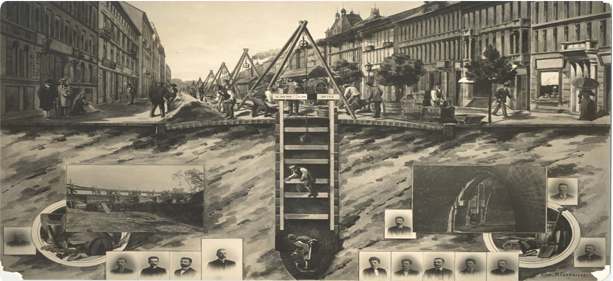
We encourage our friends and readers to make a short holiday trip to Olsztyn. After being saturated with the beauty of old tenement houses, monuments and beautifully restored secular buildings, it is a must to visit the Center of Technology and Regional Development of the "Museum of Modernity" in that city. One of his sections is devoted to Welsh engineer Isaac Shone (Isaac Shone, 1836-1918), who built in Olsztyn a unique sewage system on the European continent, draining waste ... using compressed air and gravity! Such a pneumatic sewage system functioned in Olsztyn from 1899 and its individual elements were used until the 1990s.
During
standard renovation and expansion of Wojska Polskiego and Artyleryjska streets
in 2010 an old sewage well was found and a historical
"investigation" began by the passionate amateur historian of the
city, Rafał Bętkowski. Today, in the "Modern Museum", one can not
only read about Isaac Shone, but also view various artifacts, photographs and
plans of the city recalling the course of this unusual installation.
Model of ejectory station

We will only add that the advocate of this type of sewage system was the long-time chief-engineer of water supply and sewage system in Warsaw, Alfons Grotowski. Although he preferred the competitive concept of the Dutch engineer Charles Liernur, but eventually Warsaw decided on a general sewerage system designed by the Lindleys. Interesting is that in 1906 a delegation from Warsaw under the leadership of eng. Emil Sokal visited Olsztyn and inspected the installations.
In the United Kingdom Isaac Shone has made this type of sewage system for
the Houses of Parliament, Royal Courts of Justice, Hampton Court Palace,
Eastbourne, Rangoon, & c. and in Russian Kiev.
We do not know if Isaac Shone had a chance to meet William H. Lindley, but it is intriguing to learn that the Welshman died in 1918 in Putney, a small suburb of London, where William Heerlein ended his life a year earlier ...


Engineer Hamish Douglas pleasantly surprised!
Engineer Hamish Douglas pleasantly surprised!
British Civil
Engineer Hamish Douglas works in Munich since 1979 for an international
engineering consortium. He is also Fellow in the Institution the Civil
Engineering. On the occasion of its 200th anniversary in a short filmed interview
entitled “William Lindley & Hamburg City” he comments on works of William
Lindley in Hamburg and Warsaw.
In this short, less than 9-minute film, he complements Warsaw in these words: “Perhaps the best example of [his achievements] is in Warsaw. So well preserved and so important…This is a biography of William Lindley in Polish [laughing affirmatilvely] You see the importance of the man)”.
View the link: https://www.youtube.com/watch?v=LctQLKiPop8

Pleasantly surprised with the Polish book engineer Hamish Douglas is full of admiration for William Lindley's European achievements. It makes us particularly happy because he complements also our city and the book of our author. Thank you Mr. Douglas!
Hamish Douglas, BSc(Eng) Hons, CEng, FICE, FIEI, Member of Bavarian Chamber of Civil Engineers, München, Germany is also member of Editorial Panel for Proceedings of the Institution of Civil Engineers - Engineering History and Heritage of ICE Virtual Library).

An Azeri artist on William H. Lindley in Baku
An Azeri artist on William H. Lindley in Baku

The picture shows (from the left to right) William Heerlein Lindley, Haji Zeynalabdin Taghiyev and imaginary translator on the construction-site.
We find the picture extremely fine and accurate. The Board of Societas Lindleiana congratulates Mr. Mehbaliyev an excelent idea and great artistic talent!
And artist himself:

Local media enthusiastically published the work and information about the author:
English:

William Lindley on the Isle of Wight
William Lindley on the Isle of Wight
May/June weekend breaks have already begun. Also the Lindleys were faithful to this tradition. Their favorite place was the Victorian resort of Sandown on the Isle of Wight.The picture below shows William Lindley sitting on the Boulevard bench with his daughter-in-law, Marie Ladenburg, wife of Robert Searles.

Ryszard Żelichowski, the President of the Societas Lindleyana, was not that lucky. It was cold and rainy day when he sat on the Sandown Boulevard bench at the end of April this year. The bench was almost in the same place, but the old buildings were covered by the new the 20th century additions. However, the charm of the place was still there.

Sandown Boulevard, April 2016. Phot. Hanna Żelichowska
Sandown is a seaside resort town on the southeast coast of the Isle of Wight, England.
Sandown has been a seaside resort town since the Victorian age thanks to its sands and the sunny weather on the Isle of Wight compared to other parts of the United Kingdom. Its success, along with that of other neighbouring Isle of Wight resorts led to the building of a railway connecting Sandown with Ventnor at the south and Ryde on the north coast of the island. Sandown railway station (since 1864) is still on the one remaining operational railway on the island, which now goes from Ryde Pier Head to Shanklin.
https://en.wikipedia.org/wiki/Sandown
The 19th century charm:


Encounters during holiday travel. What do the dwarfs from Wrocław and Zielona Góra have in common?
Encounters during holiday travel. What do the dwarfs from Wrocław and Zielona Góra have in common?
Attitude to the water (and size!). For example, Wrocław dwarf with funny name Wodziarz sits on the pump, in the Wrocław Market Square. For a better balance he has provided the band with two buckets. In warm weather, he is happy to share with you the water to cool off. They say, he also helps overcome "the syndrome of the previous day," and even smoothes out wrinkles…
Wodziarz (Waterman, (phot. Hanna Żelichowska)
Wrocław dwarfs - where do they come from?
Wrocław dwarfs already are so deeply blended in with the local landscape, that few people only today are asking themselves the question: where do they come from? The answer is not simple and straightforward, the truth probably only know Papa Dwarf, but there are some very plausible theories ...
Ancestors in Wroclaw
Dwarf (Skrzat in Polish) genealogy researchers
quote the Chronicle Dwarfs, where they found a surprising note: the first dwarf, which saw the world
just appeared in Wrocław! He decided to settle in the Lower Silesia. Over the years the family of Papa Dwarf
(under this name
is known today that
senior of the dwarf family) began to grow. It was not until many years later, in
the village there were people. Fortunately,
there were no conflicts of power and
influence. Young and old immediately
fell to liking to each other and the combined forces to build a city where they
live together. Years later, in honor of the dwarves living in the
past in all the main sights of the Old Town of Wrocław,
people have given tem names. So, the one
from Biskupin is called Biskupika, from Sępolno - Sepik, Szczepin
- Szczepika, Oporów - Resistor, etc ...
So if ever someone asks you who is the oldest of Wroclaw, respond without hesitation: Papa Dwarf!
More about dwarfs see the page: http://krasnale.pl/wszystko-o-krasnoludkach/
***
Zielona Góra

Gnome Palmix (phot. Hanna Żelichowska)
“Bachusiki (little Bacchus gnomes)” from Zielona Góra have a very short
history. The idea was born on the occasion of the revitalization of the
pedestrian area in 2009, when it was known that distinctive plates arranged in
a zigzag are going to disappear. The initiative to decorate the city with figures
connected with the feast of Bacchus (in the vicinity of Zielona Góra the great
wine is grown), came from the writer and city-historian Thomas Czyżniewski. In the
beginning the figures were residents of the old town. The idea picked up on the
city. For a good start the city authorities financed four sculptures. Next they
decided to invite private investors. Today in Zielona Góra there are about 30 bachusiks
and they have become a symbol of our city.
"He stood in front of Palm House, grabbed a palm tree and stayed there. The free hand is holding a glass that is sometimes filled with water. Palmix obviously wished it was the wine. "Finally some good soul pour me some wine ..." - thinks bachusik - “I do not lose good spirit”.
Palmix favorit saying is: "In life there are three important things: wine, women,
and palm to grab".
Interestingly, Palmix wears a thong of grape. This is unusual clothing for men, but Palmix says that it does not bother him. He has good fun…
Dwarf Wodziarz and gnome Palmixa are associated with the water. The founder of the first one is Wrocław Water Company (MPWiK), the Palm House of Zielona Góra of the other one.
More you can find here: http://www.bachusiki.cba.pl/bachusik/Palmix